


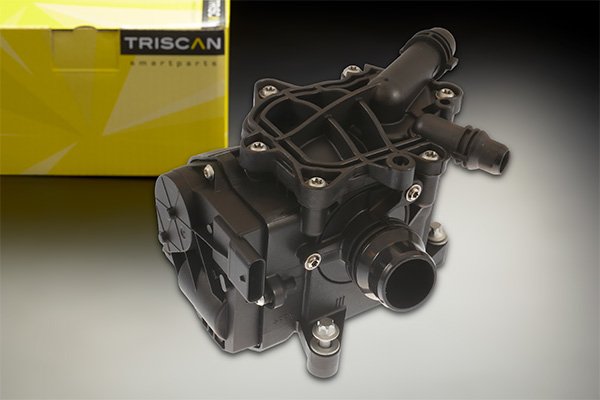
One of the oldest product programmes in our range is thermostats. The ever-increasing demands on car performance and emissions have meant that the thermostat has undergone significant technological development. So has our programme – and therefore also includes the advanced types.
For decades, the thermostat has been a central component of the car's cooling system. Its primary function is to regulate the engine's temperature by controlling the flow of coolant between the engine and the radiator. When the engine is cold, the thermostat's valve ensures that the coolant does not circulate in the cooling system. This ensures rapid heating of the engine. When the engine reaches operating temperature, the thermostat valve opens and allows cooling.
Traditional mechanically controlled thermostat
Traditionally, thermostats have been mechanically controlled. A wax element - which expands when heated - makes sure to open the valve as needed. This method is simple and reliable but has limited precision and reaction time.

Traditional mechanically controlled thermostat - Hyundai and KIA
Fully and partially electronically controlled thermostat
Modern cars with advanced engine management systems are increasingly using fully or partially electronically controlled thermostats - see our new brochure about thermostats here. These use sensors and actuators to regulate temperature more precisely and dynamically, improving fuel economy and reducing emissions.
Partially electronically controlled - Semi Thermo Module Management (STMM)

Partially electronically controlled - Semi Thermo Module Management (STMM) - Citroën, Peugeot and Mini
- Combines a classic thermostat with an electric heater or actuator.
- The ECU of the engine control can affect the opening time, but the cooling system cannot be fully dynamically controlled.
- Typically used in cars with lower emission control requirements.
- Advantage: Cheaper and simpler than fully electronically controlled system (TMM).
Fully electronically controlled - Thermo Module Management (TMM)
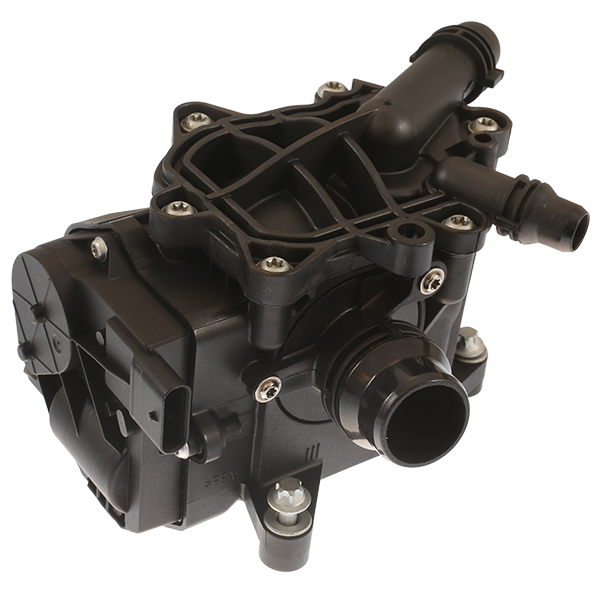
Fully electronically controlled - Thermo Module Management (TMM) - BMW
- Used in cooling systems with electric water pump, heat exchangers and sensors.
- The ECU (Engine Control Unit) controls the entire cooling circuit actively and dynamically.
- Can adapt cooling to different engine parts (e.g. cylinder head, block or turbocharger).
- Adjust the water pump speed depending on load.
- Predict cooling needs at high load and open the thermostat proactively.
- Advantage: Maximum efficiency, lower emissions, better performance and faster heating.
Thermostats in electric vehicles (EVs)
Although electric cars do not have a traditional internal combustion engine, they still need temperature control. In EVs, thermostats and cooling systems are used to regulate the temperature of:
- The battery pack – optimal operating temperature is crucial for performance and service life.
- Power electronics – inverters and chargers generate heat which must be diverted.
- Electric motors – especially at high loads or fast acceleration.
In EVs, thermostats are typically part of an integrated thermal management system that uses electrical pumps, valves, and sensors to control the flow and temperature of the coolant. The system can also include heat pumps, which can both cool and heat components depending on demand.
Thermostats of the future
With the development of software-controlled cooling systems and intelligent energy management, the thermostat becomes more than just a valve – it becomes part of the car's digital brain. This opens up for even more efficient temperature control, especially in electric and hybrid vehicles, where energy saving is paramount.