


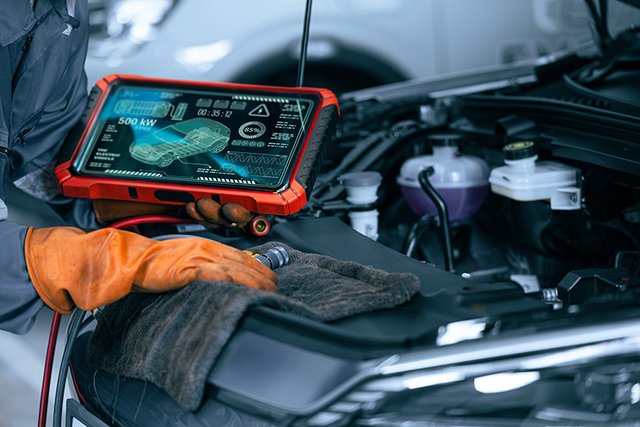
For years, Norway has been the world's pioneer in electrification of the car fleet, and the country is now in a phase that the Danish aftermarket is only just beginning to approach. At AUTIG's (The Danish Automotive Industry Trade and Industry Association) annual general meeting in Aarhus in May 2025, the Norwegian Automobile Industry Association (NBF) gave an insight into what lies ahead when Denmark really follows in Norway's footsteps. NBF represents over 1,500 companies in the Norwegian automotive industry — dealers, importers, repair and paint shops, tire companies, car glass workshops and independent repairers — and the organization's data paints a picture of a market in rapid, structural change.
Why did it go so fast in Norway?
Norway's lead is no coincidence. Since 1990, the country has systematically removed economic barriers for electric cars: no purchase and import tax from 1990, exemption from road tolls from 1997, free parking in public spaces from 1999, VAT exemption on purchases from 2001 and on leasing from 2015, as well as access to bus lanes. The combination of low road tolls, favourable taxation and good charging infrastructure has made the electric car the obvious choice for Norwegian consumers over three decades. It was not until 2026 that the full VAT exemption was reduced, so that 25 percent VAT is now paid on the part of the purchase price that exceeds NOK 300,000 (Approx. € 29,000).
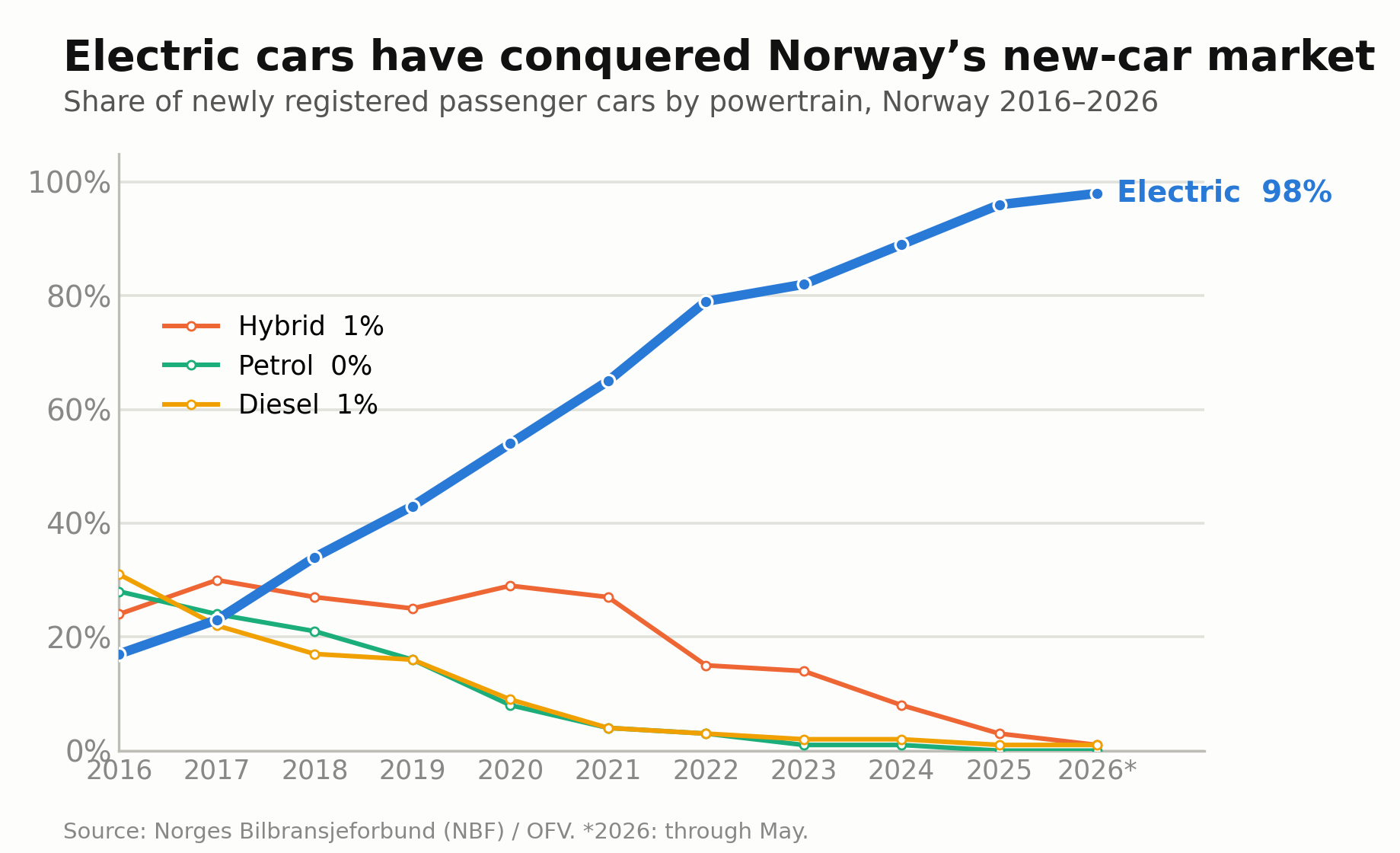
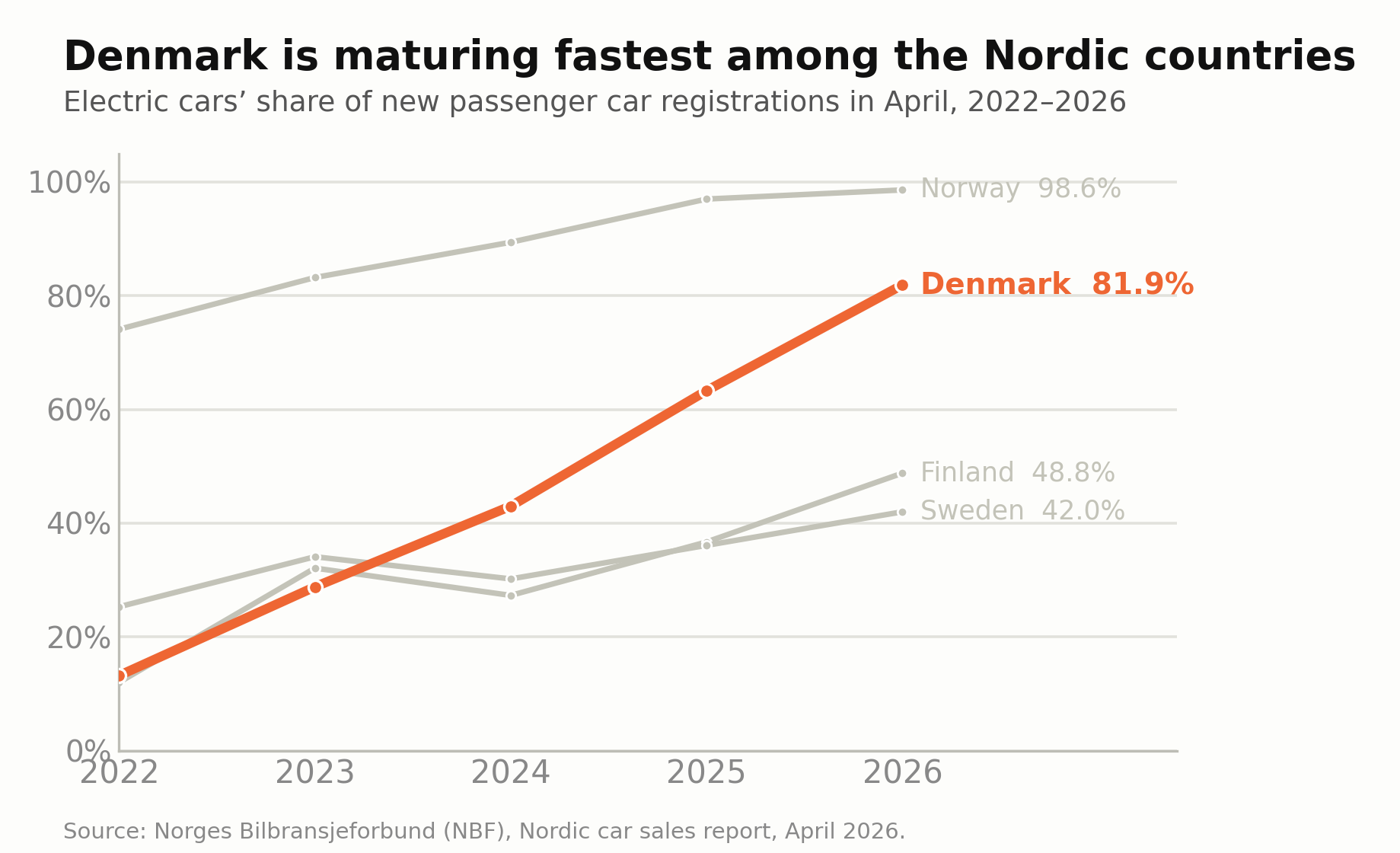
The results speak for themselves. In April 2026, electric cars accounted for 98.6 percent of new car sales in Norway, while the share in Denmark had reached 81.9 percent — two out of three new passenger cars sold in the Nordic region are now electric. Seen over a longer period of time, the development in Norway is almost linear: from 17 percent of new car sales in 2016 to 98 percent in 2026, while petrol and diesel cars have practically disappeared from the new car market. However, Denmark has the most significant growth curve in the Nordic region: from an electric car share of 13.2 percent of new car sales in April 2022 to 81.9 percent four years later — a maturation of the market that NBF itself describes as unusually fast.
In the total Norwegian car fleet (2.93 million vehicles as of May 2026), electric cars are now the largest single group with 33.7 percent, ahead of diesel (30.4 percent) and gasoline (23.5 percent). The Tesla Model Y is the most widely used model with over 100,000 registered examples — approximately every 29th passenger car on Norwegian roads today is a Model Y. NBF's projection indicates that over 60 percent of the Norwegian passenger car fleet will be electric by 2030. For vans, development is slower: electric cars accounted for only 10.2 percent of the total van fleet in May 2026, although they accounted for 53.7 percent of new sales.
The aftermarket feels it on the bottom line — but the gap is narrowing
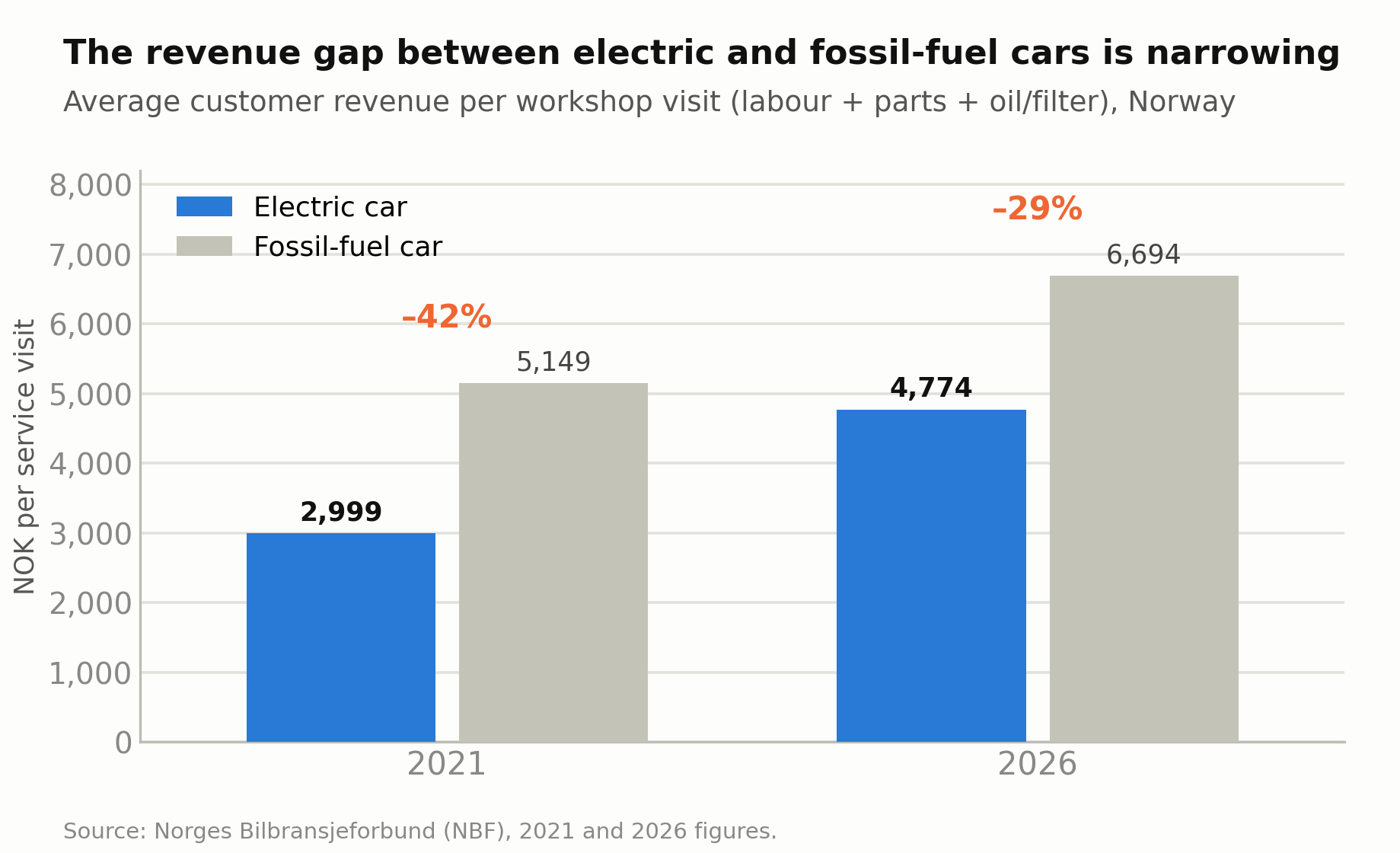
The most remarkable thing for the Danish aftermarket is probably the consequences for the workshops' turnover. NBF's figures show that in 2021, an electric car generated 42 percent less revenue per workshop visit than an equivalent fossil-fueled car (2,999 versus NOK 5,149), primarily because there are no oil and filter changes, and because both working hours (-31 percent) and parts sales (-21 percent) were significantly lower. Interestingly, this gap has narrowed significantly since then: in 2026, the difference had narrowed to 29 percent (4,774 versus 6,694 kroner), driven by the fact that the working hours and parts sales of electric cars are now only 11 and 9 percent below those of fossil cars, respectively. Part of the explanation is that warranty work in electric cars has fallen less than expected, and that several electric cars are now old enough to require regular wear and tear service.
The most frequent repairs on electric cars in 2026 are brakes, steering/suspension and tires — as well as an increasing number of cases of 12-volt problems, air conditioning and charging modules. However, NBF's forecast for total hourly sales to garages still points to a decline of 11.7 percent towards 2030, with a turning point as early as 2026, as an increasing share of the car fleet becomes electric. Norway's largest car importer, Harald A. Møller, has determined through analysis that an additional 150,000 workshop visits are required to compensate for the lost parts sales.
Another important finding is about customer loyalty: diesel owners have become more indifferent to the type of workshop they use — 35 percent now give it less weight, 12 percentage points above average. Electric and hybrid owners, on the other hand, are more loyal to brand workshops than average, with 17 percent of EV owners expecting brand workshop status to have a greater impact on their future choices. However, price remains the most important factor for all car owners, regardless of powertrain. Today, 85 percent of EVs' workshop visits are made to brand garages, compared to only 21 percent at independent garages and chains — a significantly skewed picture compared to the traditional market.
MOT, batteries and damages
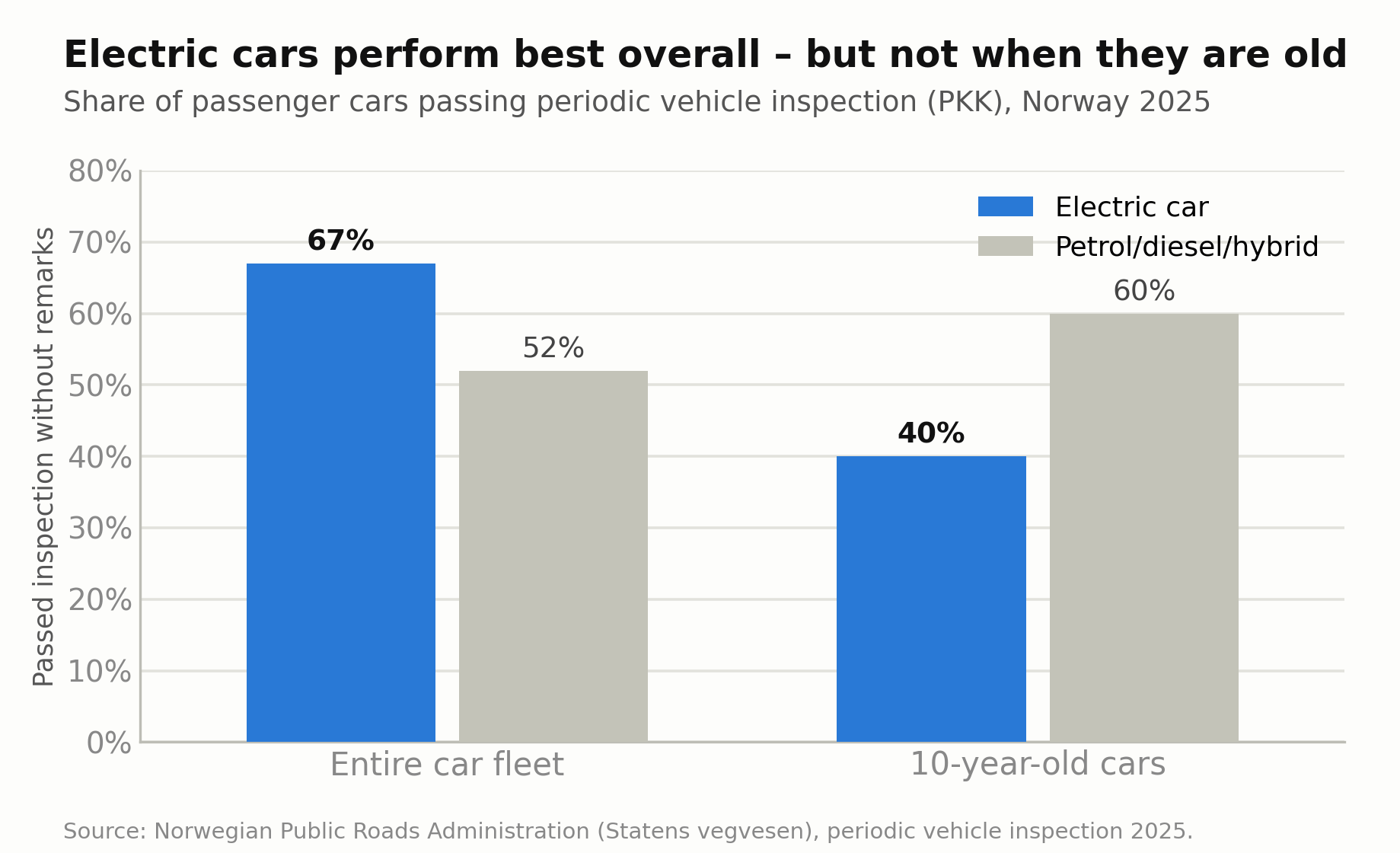
Data from the Norwegian Public Roads Administration on periodic vehicle inspections (similar to the Danish inspection programme) provide a nuanced picture. Across the entire car fleet, electric cars actually perform better than petrol, diesel and hybrid cars at the inspection — 67 percent are approved without remarks, compared to 52 percent for the other powertrains. But for 10-year-old cars, the picture is reversed: here, only 40 percent of electric cars are approved, compared to 60 percent for older fossil cars. The most common faults on old electric cars are brake drums/brake discs, suspension and springs/stabilizers — typically with twice as high a failure rate as on similar fossil cars, presumably because the higher weight and torque of electric cars wear out chassis components more. A separate finding shows that 3.4 percent of 10-year-old electric cars fail due to too low a boiling point in the brake fluid compared to only 1.0 percent for fossil cars — possibly a sign of a lack of service.
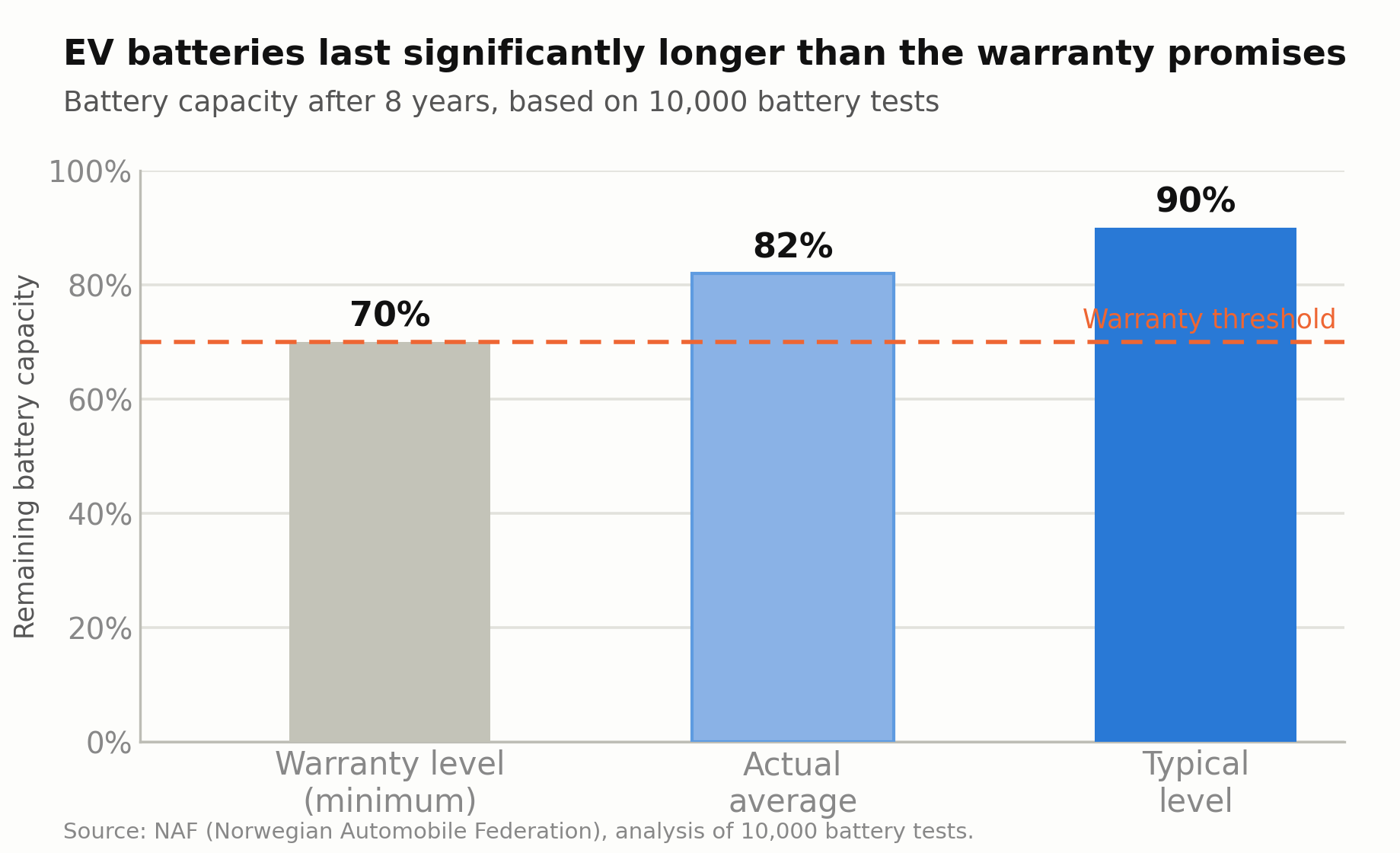
On the battery front, the news is mostly positive. An analysis of 10,000 battery tests from the Norwegian Automobile Association (NAF) shows that electric car batteries have an average of about 90 percent capacity left after 8 years — well above the general warranty requirement of a minimum of 70 percent within 8 years or 160,000 km. None of the tested cars were below the warranty limit, which suggests that manufacturers have been conservative in their warranty promises.
The damage claims market, on the other hand, points in a more complex direction. Although ADAS (advanced driver assistance systems) systems are expected to reduce the number of accidents, international simulations (ICDP) show that the total value of the claims market is only expected to decrease by up to 14 percent by 2030. At the same time, NBF's own figures for the period 2019-2025 show that the actual number of collision damage and glass damage in Norway has increased faster than the car fleet itself — a development that does not yet reflect the expected ADAS gains.
What does this mean for Denmark?
Norway's experience paints a picture of an aftermarket in transition rather than collapse: the loss of revenue per car is real, but less dramatic than feared and narrows as more electric cars age. On the other hand, the value is shifting — towards brakes, chassis and electronics rather than engine oil — and brand workshops seem to have a solid lead among electric car owners so far. For Danish players in the aftermarket, including suppliers of spare parts, the clear message from Norway is that preparation for competence change, chassis service and safe handling of high-voltage components should be at the top of the agenda, while the share of electric cars in Denmark in the coming years is moving towards Norwegian levels.
The article is based on the presentation "Electric cars in practice: Norwegian experiences for the Danish aftermarket", held by the Norwegian Car Industry Association (NBF) for AUTIG's general meeting in Aarhus.